


Walk into a tea shop in Japan and nobody talks about "ceremonial grade" or "culinary grade." Those terms don't really exist there. They were invented for Western markets — a simple hierarchy to help consumers navigate a complex category.
Simple, but not accurate. There is no international standard for matcha grades. No regulatory body defines what "ceremonial" means. No certification governs who can use the word. Quality differences in matcha are real and they matter enormously — the labels are just an unreliable guide to them.
What the grades actually mean
Most matcha sold in Western markets sits somewhere on a three-tier ladder: ceremonial at the top, culinary at the bottom, and a murky middle tier that goes by names like "premium," "latte grade," or "everyday." Here's what each actually means — and where the labels break down.
Culinary grade
Describes later-harvest, more astringent material suited to cooking and lattes — a real distinction, but not a ceiling. A well-sourced culinary matcha from a disciplined producer can outperform a carelessly labelled ceremonial. If you're baking or making iced lattes, culinary grade is entirely appropriate — the nuance gets lost in other flavours anyway.
Premium / latte grade
A catch-all middle tier with no consistent definition. Sometimes it means a second-flush leaf blended for smoothness in milk. Sometimes it's just a ceremonial positioned more accessibly. Worth treating with the same scepticism as the others — ask about origin and cultivar rather than trusting the label.
Ceremonial grade
In Japan, ceremonial matcha (点前用抹茶) refers to matcha prepared for the tea ceremony: whisked with hot water, consumed straight, no milk or sweetener. That requires genuine quality — clean dissolution, present aroma, no bitterness. In the West, the phrase has become a loosely applied premium signal. Some brands use it accurately. Many don't. The honest test: make it in hot water. If you wouldn't drink it that way, the grade claim is aspirational at best.
Competition grade
This one comes from Japan rather than Western marketing. Competition grade — or shuppin cha — refers to tea produced specifically for entry into formal competitions: Japan's National Tea Competition, the World Green Tea Contest, the Japanese Tea Selection Paris. Small batches, exceptional care, the farm's absolute finest. It doesn't mean the tea won, but it does mean it was made to a standard worth competing with. All of Romi's matcha is competition grade.
What actually determines quality
These are the signals worth paying attention to.
Origin
Yame (Fukuoka), Uji (Kyoto), Nishio (Aichi). Named regions signal proximity to the farm. No origin mentioned usually means blended or bought on the commodity market.
Cultivar
Okumidori brings umami and depth. Saemidori offers sweetness and a clean finish. Yabukita is the most widely planted cultivar in Japan — reliable, rarely exceptional. A brand that names cultivar is close to the source.
Harvest season
First flush (ichiban-cha), harvested in spring, is the standard for premium matcha. Second flush leans bitter. Most quality matcha is first flush by default — it's still worth knowing.
Competition record
Farms that compete — and place — at Japan's National Tea Competition (全国茶品評会) operate at a demonstrably high standard. An awarded farm is a more meaningful credential than any grade designation.
How Romi approaches this
We source single-origin matcha from Yame, Fukuoka — a region with one of the longest competition records in Japan for tencha and gyokuro. Every matcha we carry is competition grade: produced by award winning producers that enter Japan's most prestigious tea competitions, in small batches, with first-flush harvests and long shading windows.
We name the cultivar, the harvest, the farm region. Not because it's better marketing, but because it's the only honest way to tell you what you're buying.
Our matcha is produced for ceremonial preparation. It also performs exceptionally in lattes and cooking. The grade doesn't change — the use does.
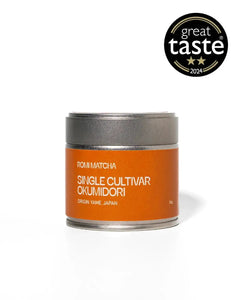
Single Cultivar Okumidori Matcha — First-flush Yame, competition grade. Paris Tea Selection Gold. World Green Tea Contest Gold. Great Taste Double Gold.
Ceremonial Blend #01 — Our signature Yame blend, competition grade. World Green Tea Contest Gold. Made for daily preparation.
Shop all matchaIs ceremonial grade matcha actually better?
Not always — because the term has no regulated definition. "Ceremonial grade" can mean anything a brand wants it to. A more reliable signal is named origin, named cultivar, and a first-flush harvest. If a matcha tastes good whisked in hot water with nothing added, that's the real test.
What is culinary grade matcha?
Culinary grade typically refers to later-harvest matcha with a more astringent flavour profile, better suited to recipes where the tea is a supporting flavour — baked goods, lattes, ice cream. It's a genuine quality distinction, but a well-sourced culinary grade can outperform a low-quality "ceremonial."
What does single-origin matcha mean?
Single-origin means the matcha comes from one specific farm or region, rather than being blended across multiple sources. It allows traceability — you can know exactly where the tea was grown, by whom, and under what conditions. Romi sources exclusively from Yame, Fukuoka, Japan.
What is the best matcha in Japan?
Japan has several renowned matcha-producing regions — Uji (Kyoto), Nishio (Aichi), and Yame (Fukuoka) among them. Yame is particularly known for award-winning gyokuro and tencha, grown at altitude with long shading traditions. Farms in Yame have won more national tea competition titles than any other region for certain categories.
How do I know if my matcha is good quality?
Whisk 2g with 70–80°C water and taste it straight — no milk, no sweetener. Good matcha should be smooth, present, slightly sweet with clean umami. Bitterness or flatness suggests lower quality or old stock. A vivid, saturated green colour is also a sign of high chlorophyll content from proper shade cultivation.