


In Japan, the most serious tea producers don't just grow matcha. They compete. Their finest work — made in small batches, shaded longer, harvested more precisely than anything else they produce — gets entered into formal competitions judged by specialists. That tea has a name: Shuppin or competition grade.
All of Romi's matcha is produced to this standard, by farms in Yame, Fukuoka with decades of competition history behind them. Here's what that actually means — and what it takes to go further.
What "competition grade" really means
In Japan, tea producers enter their very best work into formal competitions — regional, national, and international. The tea they submit is their finest: made in small batches, shaded longer, harvested more precisely, stone-milled more slowly than anything else they produce.
That submitted tea is called shuppin cha in Japanese. It translates simply as "submitted tea." And this is the key point: it tells you the tea was good enough to enter. It does not tell you whether it placed.
How Japan's tea competitions actually work
Japan's National Tea Competition has been running since 1947. Every year, over 830 teas from 18 prefectures enter — judged blind, by specialists, across five criteria: the appearance of the dry leaf, the colour of the brewed liquor, aroma, taste, and the condition of the leaf after steeping.
There are three award tiers — first, second, and third rank. Most entries receive nothing. Roughly 30% receive any award at all. First rank goes to fewer than 5%.
A tea that wins at this level carries that recognition for life. It's not a campaign. It's a record.
So what should you actually look for?
When a brand says "competition grade," that's a quality signal — the tea was produced to competition standard. But the more meaningful question is: did it win?
Awarded tea
A tea that received a prize at a recognised competition. Worth asking: which competition, which tier, and which year. Not all competitions carry the same weight.
Not all competitions are the same. There are two distinct types — and understanding the difference is what makes an award actually mean something.
Green tea specialist competitions
These are judged entirely by people who spend their careers in Japanese tea — producers, graders, and specialists who can assess a tencha or matcha against decades of category knowledge. Japan's National Tea Competition (running since 1947), the World Green Tea Contest held in Shizuoka, and the Japanese Tea Selection Paris all fall into this category. Entries are evaluated blind, against strict criteria specific to each tea type. A gold prize here is a verdict from people who know exactly what they're tasting.
General food and drink award programmes
These evaluate excellence across food and drink broadly — judged by buyers, chefs, food critics, and industry professionals rather than tea specialists. They can be rigorous and meaningful quality signals, but they're assessing overall excellence rather than depth within Japanese tea specifically. Winning against that kind of field — where your matcha is judged alongside everything else on the shelf — is its own kind of credential.
Award-winning farm
A producer with an actual competition record across both types — not just a product that entered once. This is the most durable credential in Japanese tea, and the one that tells you the most about the standard you're buying into.
Where Romi sits in this
Every matcha we carry is competition grade — sourced from farms in Yame, Fukuoka that produce their tencha specifically for competition entry. Small batches, long shading windows, first-flush harvest. That's the baseline.
And then it went further — across both types of competition.
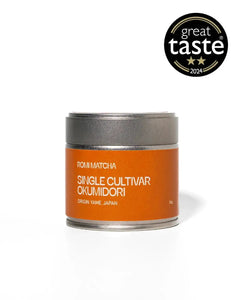
Our Single Cultivar Okumidori has been awarded Gold at the Japanese Tea Selection Paris 2026 — a specialist competition judged blind by Japanese tea experts. It also won Gold at the World Green Tea Contest 2023, held in Shizuoka and judged by Japanese tea specialists. And it earned Great Taste Double Gold (two stars) from the Guild of Fine Food — the UK's most respected food and drink blind-tasting programme, judged across all categories by buyers, chefs, and food critics.
Our Ceremonial Blend holds a World Green Tea Contest Gold, and Saemidori Single Cultivar holds a World Green Tea Contest Silver — the same specialist Japanese competition.
Single Cultivar Okumidori Matcha — Paris Tea Selection Gold.
World Green Tea Contest Gold.
Great Taste Double Gold.
Ceremonial Blend #01 — World Green Tea Contest Gold.
Single Cultivar Saemidori Matcha — World Green Tea Contest Silver.
Shop all matchaWhat does competition grade matcha mean?
It means the tea was produced to the standard a farmer submits for formal competition — their very best work, made in small quantities with exceptional care. It does not mean the tea won an award. In Japan, the term for this is shuppin cha (出品茶), meaning "submitted tea."
Is competition grade matcha better than ceremonial grade?
They're different systems. Ceremonial grade is a Western marketing term with no regulated definition — any brand can use it. Competition grade refers to a specific Japanese practice: tea entered into formal judging. A tea that has actually won at competition level carries a more verifiable credential than either label alone.
What is the Japan National Tea Competition?
It's the most prestigious domestic tea competition in Japan, running annually since 1947. Over 830 teas from across 18 prefectures compete each year, judged blind by specialists. Only around 30% of entries receive any award. Fewer than 5% reach first rank — the highest tier.
What does award-winning matcha mean?
It means the tea — or the farm that produced it — has received a prize at a recognised competition. The questions worth asking are: which competition, what tier, and which year. An award-winning farm has a competition record, not just a single lucky entry.
Where does Romi matcha come from?
Romi sources from farms in Yame — one of Japan's most decorated tea regions. Our matcha holds the Paris Tea Selection Gold Prize, Japan Gold Award, Japan Silver Award, and Great Taste Double Gold. We name the cultivar, harvest, and region for every product we carry.